TigerTag
What is TigerTag?
TigerTag gives every spool a memory of its own. A small NFC chip holds everything about the filament — brand, material, colour, how it likes to be printed — so you never have to guess, label or remember. Tap it with your phone and the spool tells you itself. Free, offline, already on more than 2,500,000 spools.
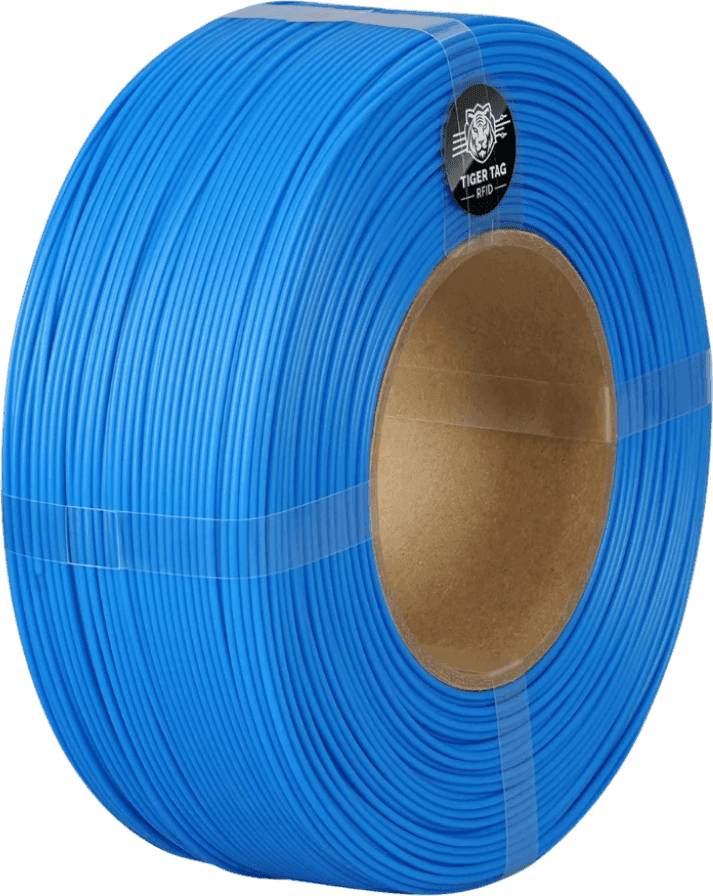
TigerTag is the standard. TigerSystem is everything around it.
Free apps and optional hardware, all speaking the same chip.
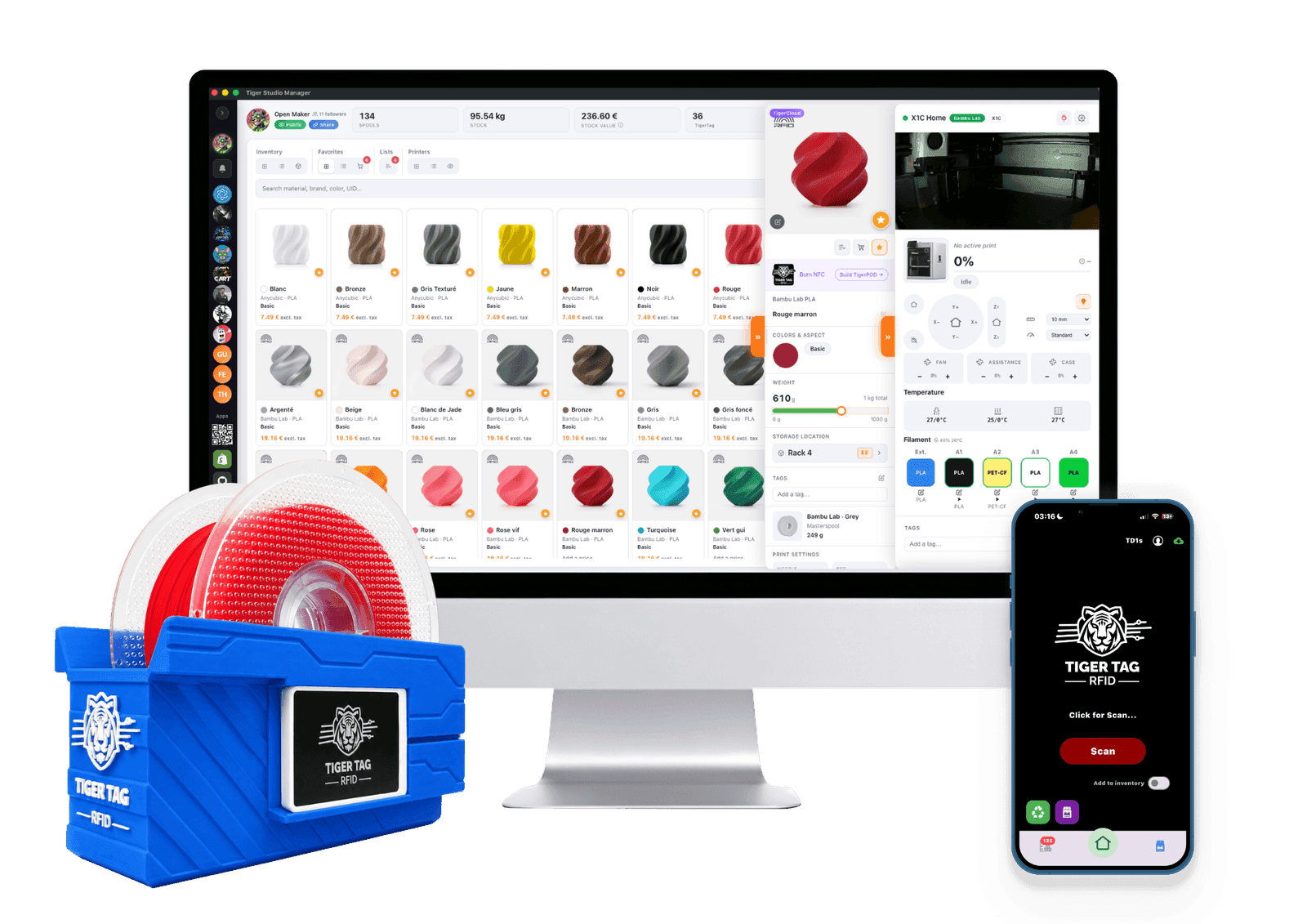
Tiger Studio
The free desktop app — filament manager and printer manager on one screen. Windows, macOS, Linux.
Tiger NFC Connect
The mobile app: tap a spool with your phone, push the filament straight into a printer slot.
TigerPOD
A CD player, for spools: drop one on it, your computer reads it. Print it yourself or get the kit.
TigerScale
A connected scale that keeps grams-left honest, spool by spool.
How it works
Same technology as paying with your phone. Same gesture, too.
- 1
The chip is written
At the factory for tagged brands — or by you, on any blank NTAG chip. Everything the spool is, stored on the spool.
- 2
You tap it
Any NFC phone reads it instantly. No account, no cloud, no reader to buy — the spool reader is already in your pocket.
- 3
Everything follows
The apps put the spool in your inventory and hand the right settings to your printer — through the app, on six printer brands.
What the chip can do
Six jobs — and the last three exist nowhere else.
Says what it is
Brand, material, exact colour, diameter. The identity lives on the spool itself — not on a box in the bin.
Carries its settings
The temperatures the maker actually recommends, read straight from the chip. No more "pretty sure it was 215".
Knows what's left
Grams remaining, kept honest as you print or weigh — so a long print doesn't die at 92%.
Proves it's genuine
A TigerTag+ carries a signature tied to its chip's unique ID. A copied chip has a different ID — the check fails. Tap to verify.
Never frozen
The manufacturer fixes a temperature six months after the spools shipped — and every app picks it up, on every spool already out there.
Outlives the spool
Empty spool? The chip is rewritable: a new spool, a plain NFC tag for your home automation, whatever's next. Zero e-waste.
Yes — you can make your own, at home
TigerTag isn't only written in factories. A blank NTAG 213 chip costs a few cents, anywhere chips are sold — and the cheapest writer is the phone in your pocket: Tiger NFC Connect writes it, free. Prefer a computer? Tiger Studio does it with any ACR122U-compatible reader. Pick the product, write, stick it on. Your no-name spool now introduces itself like the factory-tagged ones.
Prefer ready-made? Chips and the TigerPOD reader kit are in the shop — or 3D-print the Pod yourself, the file is free.
The step-by-step guide →Two chips, one standard
Same silicon in the spool. The + adds an online layer on top — nothing is taken away.
TigerTag
100% offline. Everything lives on the chip: identity, settings, what's left. Works with no internet, no account — forever.
TigerTag+
The same offline chip, plus an online product sheet: photos, datasheets, and corrections that reach every spool already shipped. The proof-of-origin signature lives here too.
A standard, not a gadget
TigerTag is the most deployed third-party RFID protocol in the world: more than 2,500,000 chips written at the factory by filament brands like eSun, Rosa3D, Sunlu, Landu, R3D and JamgHE, backed by a public registry anyone can read.
The ambition is simple — become to 3D-printing materials what the barcode became to the shelf. An identity every spool carries, free for anyone to read, owned by no machine maker. And it's an open protocol: any NTAG 213, 215 or 216 works, any ACR122U reader works, nothing is required to start.
They announced it themselves
Public posts on their own channels — not our press release.
 12.03
12.03“ROSA 3D FILAMENTS has officially integrated the open TigerTag RFID protocol across 100% of our filament production.”
More than 250,000 spools already produced with TigerTag.
Read the announcement → 08.03
08.03“R3D Filament has officially begun large-scale deployment of the open TigerTag RFID protocol across its filament production in Europe.”
Open protocol. Offline signature. Cross-brand interoperability.
Read the announcement → 09.02
09.02“eSUN has officially integrated TigerTag RFID technology!”
Launching as a pilot programme in the French market, expanding across Europe.
Read the announcement →
TigerTag, in five questions
Is TigerTag free?
Yes. Reading a spool is free and offline for everyone, the desktop and mobile apps are free, and the protocol is open — any NTAG 213, 215 or 216 chip can carry a TigerTag.
What is the difference between TigerTag and TigerTag+?
Same chip in the spool. TigerTag is 100% offline. TigerTag+ adds an online product sheet — photos, datasheets, corrections that reach spools already shipped — and the signature that proves the spool is genuine.
Do I need to buy anything to use it?
No. Any NFC phone reads a tagged spool as it is. If you want to write your own chips, a blank NTAG costs a few cents and any ACR122U-compatible reader works.
Which filament brands ship TigerTag?
eSun, Rosa3D, Sunlu, Landu, R3D and JamgHE write TigerTag chips at the factory — more than 2,500,000 spools so far, announced publicly on their own channels.
Does TigerTag work with my printer?
The chip is readable whatever you print on. Through the free apps, the settings reach printers from Bambu Lab, Creality, Elegoo, Flashforge, Snapmaker and Anycubic.
Free. No subscription. Works offline. Nothing locked in.
Get Tiger Studio on your desktop, and the app on your phone.